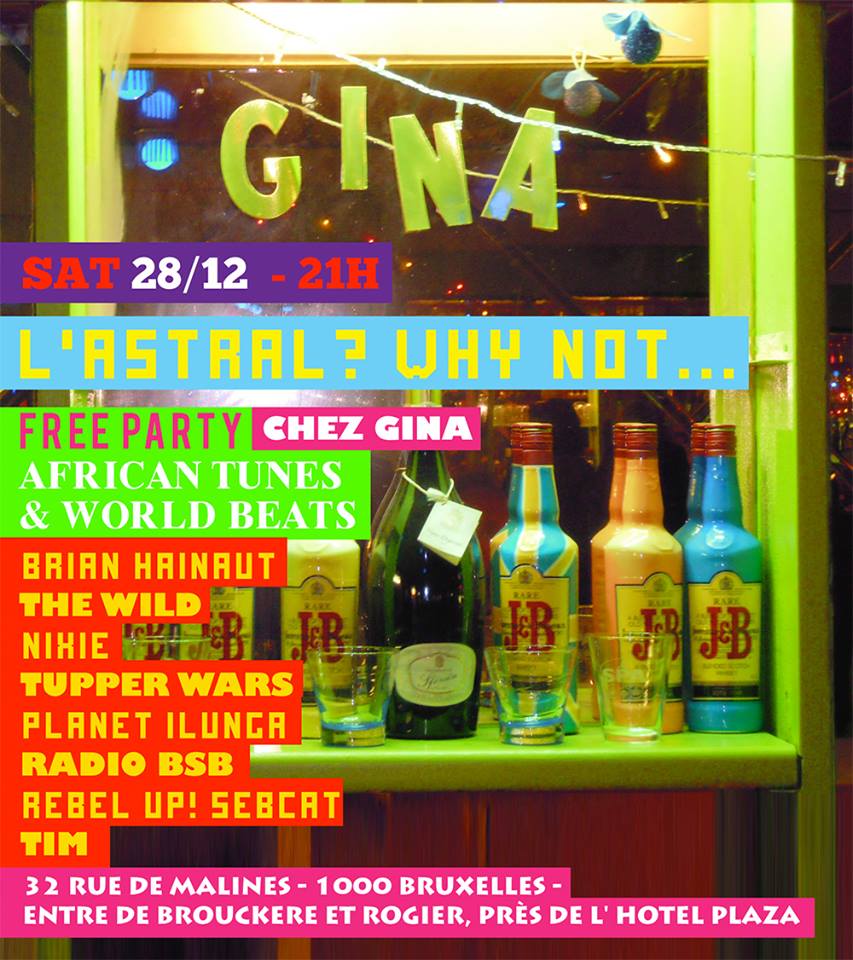
Brussels finest global bass and world beats collectives unite to invite Uproot Andy (Brooklyn/NY) to Brussels for a serious night of cumbia & bass!
As a co-founder of the monthly tropical clubnight Que Bajo and the Que Bajo Label, UPROOT ANDY is a pioneer dj producer of the global bass movement. His productions and remixes of cumbia and global bass are always top quality and played by many global dj’s with good taste. Get ready for his fast mixing, tropical bounce and a serious dance fever! 🙂
Rebel Up! Soundclash & Lowup will provide the wildest contemporary global dance hits from the Caribbean to Latin America, Africa and beyond! DJ’s representing Rebel Up! are SebCat & Leblanc and Max Le Daron & dj Mellow will be showcasing the bouncy LowUp sound.
and ofcourse as always at Bonnefooi > FREE IN! FB event here.
from 22:00 till………
Steenstraat 8 Rue des Pierres,
1000, BrxHell
Our very first radio show session, “emission 0” on Radio Campus Bxl, broadcasted on 11th of january and to be repeated several times during the month. The show was actually recorded in late august and we had to wait a while before it was accepted into the Campus programme schedule. We kick off with 2 songs, followed by a label focus about the Sahel Sounds label that mostly releases current folk & electronic music from the sub Saharan region. Then we played our albums of the month, which were Hailu Mergia (on Awesome Tapes From Africa) and Grand Kallé & l’Orchestre Jazz (on Planet Ilunga), followed by a global style focus on Pandza music from the south of Mozambique, a new electronic Marrabenta Shangaan style. In the nightshop segment we interview local Afghani shop owner Raza Wasiq of the Economat shop on Av Stalingrad and he chooses 2 ‘Hazzari’ songs to play. To end, a freestyle mix of Rebel Up! sounds. download here > http://www.mediafire.com/download/mrt…
Back in business for this new year full of promises. At least this next Saturday we’ll make sure you’ll be grooving at Cafe De Vinger. Hot music are welcome in these times and Christmas has been kind on new sound collecting. Get ready for mashing tunes from all around the world. This time the benefit will go to activity project for Brazilian street kids.
SebCat & Palm M will be happy to see you there, with colourful sounds & visuals. FB event here >
Brazilian NGO Tiaozinho
During the next 3 months, a sports project for children and adolescents in one of the Sao Paulo favela’s will be organised. The aim is to stimulate social skills, values like team spirit, playing together and fairplay so that the youths can make positive decisions in their future life, but the main goal simply is to just have fun and enjoy themselves. Sports that will feature are football, volleyball & circus techniques and some other activities. Also friendly tournaments will be organised for the children as an end goal to all their sports training and with an incentive for them to invite their family into their playing environment as part of the social process. For this project, they need to raise money to buy sports equipment (balls, nets, clothing etc) and to cover other costs. www.tiaozinho.org.br
Rebel Up! Soundclash in Den Haag Sat. 11th of January @ Cafe De Vinger
Starts at 21.00
Entrance fee : 3 euro (free entrance before 22.30)
Bagijnestraat 25 (small street right next to the Stadhuis/Bibliotheek building in Spui)
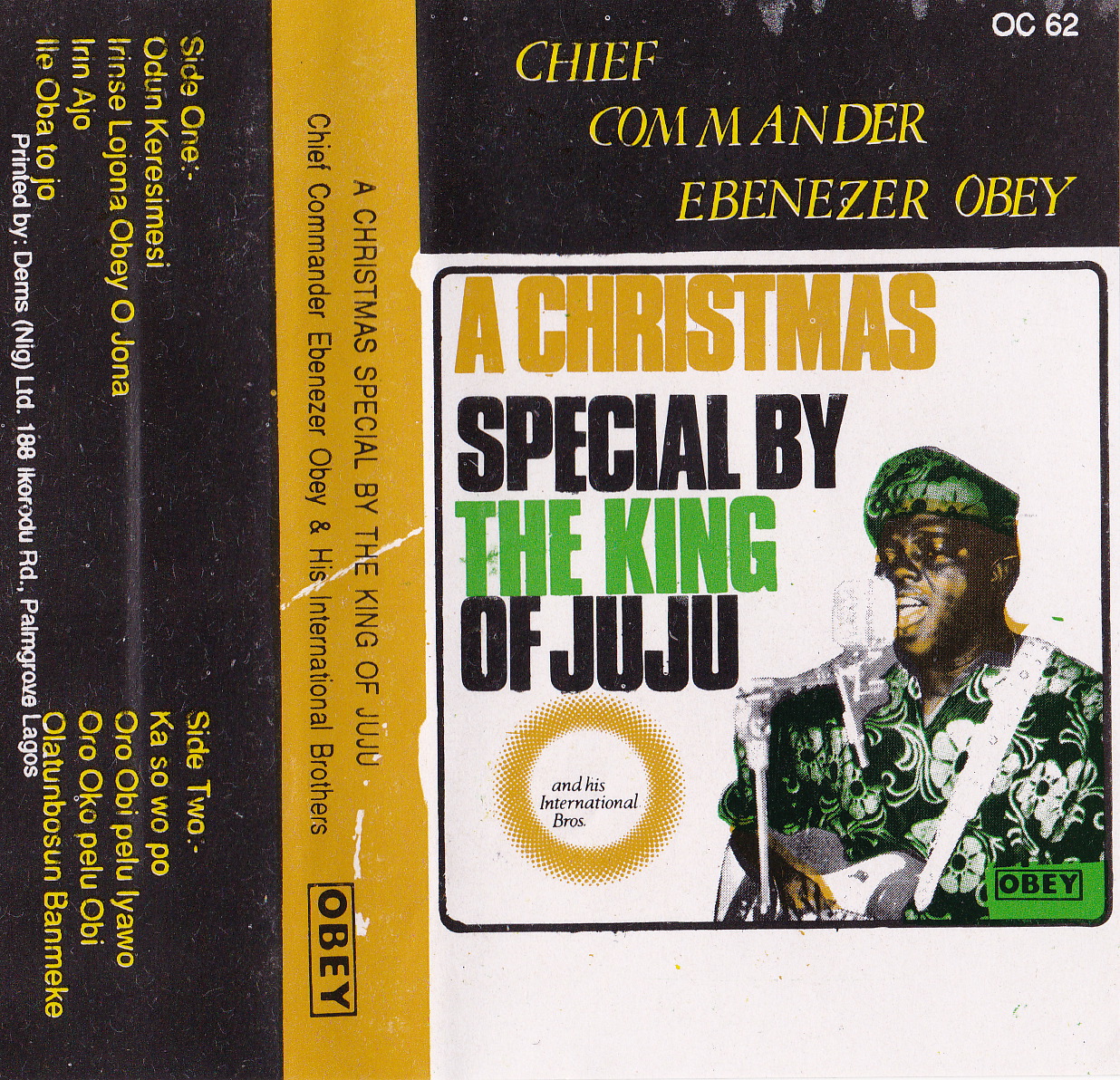
Special holiday greetings from Rebel Up! as we uploaded a very special vintage cassette for the Awesome Tapes From Africa blog. See the original post here or below.
Happy holidays y’all. My best good homie Seb from Brussels (part of the wonderful Rebel Up! outfit) blessed this xmas eve with a crucial Nigerian juju Christmas-themed tape by an Awesome Tapes From Africa favoriteguy, check out his description:
Ho Ho Ho! Christmas, Nigerian juju style by Chief Commander Ebenezer Obey & His International Brothers: A Christmas Special By The King of Juju! Since the 50’s Ebenezer Obey had been crafting his special juju-highlife sound, which is a mix of Yoruba percussion, talking drums, electric guitars and vocals in Yoruba. Later in his life he only started playing Christian gospel music (a fate which many Nigerian musicians seems to befall from a certain age onwards) and he passed away in 2011 in Lagos university hospital at the age of 67.
This tape was recorded sometime in the 60’s with his then-band International Brothers. It was a golden find in one of the many Nigerian stalls around London’s Brixton market last spring. Both sides are filled with heavenly sweet jangling guitars, muffled percussion, talking drums and festive Yoruba singing, with some surprise Christmas melodies played as one continuous medley in lo-fi tropical spheres. As the title already said, the chief was the self-proclaimed king of juju and we can only bow down to his legacy. Listen to these funky Christmas waves and have a great one! A special Christmas gift to you all!
Bouyon is a kind of soca music from the Lesser Antilles island of Dominica, which originated in the late 80’s and is said to be invented by the band Windward Carribean Kulture.
Also, ‘bouyon’ is creole for the French word ‘bouillon’, which means ‘stock’ or ‘soup’ as a metaphor for the music which is a blend of different local (Carribean) styles, a musical ‘soup’.
According to Wikipedia: “Bouyon in effect represents a fusion of zouk and soca music but also draws upon cadence-lypso, jing ping and lapo kabwit elements in term of rhythms. Bouyon music is very dependent on the drum machine, cowbell and keyboards with guitars receding into the background. As such, it has a very strident rhythm and is aptly referred to as jump up music by the population in Guadeloupe and Martinique.”
some examples of these fusion styles >
Lapo kabwit
Cadence-lypso
An article at Cakafete Family elaborates further; “Like the other Francophone musics of the Lesser Antilles, Dominican folk music is a hybrid of African and European elements. The quadrille is an important symbol of French Antillean culture, and is, on Dominica, typically accompanied by a kind of ensemble called a Jing Ping band. In addition, Dominica’s folk tradition includes folk songs called bélé, traditional storytelling called kont, masquerade, children’s and work songs, and Carnival music.”
some Jing Ping sounds:
From the start, bouyon bands and producers mixed up acoustic, electric and electronic sounds and instruments like accordeon, synth, organ, guitar, bass, brass, drums, steel pans etc.
A mix by dj Easy of old skool bouyon:
But under the influence of a global dj-culture – the emergence of dj’s, mc’s, producers, clubs and new music production technologies – the bouyon sound has evolved into rough digital club music. In the Carribean, in terms of music output, probably the most dense and diverse region of this planet, it’s of no surprise that ragga dancehall from Jamaica or Martinique and soca from St Lucia, Grenada or Trinidad, were a big influence on the evolution of bouyon.
Reketeng or bouyon dancehall (muffin):
Bouyon soca from St Lucia:
Power soca from Grenada:
“On pourrait même faire un deuxième volume du kamasutra en regardant les différents « main a tè…, fess en lè ».”. (“Looking at the different “hands on yer…, booty in the air”, one could even make a second volume of the Kamasutra”)
A recent new substyle – from the last 3 years or so- is called ‘hardcore‘, with ‘bouyon gwada‘ as its Guadeloupean equivalent. It is bouyon with raw, often explicit sexual or violent lyrics, either in English, French or Creole, on heavy percussive riddims while melodies sound cheap, simplified and stripped down. Often one succesful riddim has, in a true reggae dancehall style, different versions. The accompanying dance moves are a mix of booty shaking and dynamic adult sex positions, kind of similar to American twerking, Ivorian mapouka (https://www.youtube.com/watch?v=0IbJZ23yrUA) or Brasilian ‘popozuda’ shaking in baile funk (https://www.youtube.com/watch?v=dnnApv5940A).
This new bouyon from the French Antilles is gaining popularity all over the Carribean, competing with the local dancehall scene for the attention of the audience, although the lines between the two scenes are blurred. With dancehall singers doing bouyon and vice versa, playing for the same kind of audience.
Internationally, it took until december 2012 before the first dominican and guadeloupean mc’s and dj’s came to Paris, home to a large part of the antillian diaspora in France. There’s a 50 min documentary in French & creole of the first and impressive performance in Paris of Suppa, Gaza Girls, Dj Joe and others, although the questions of the interviewer are not necessarily more interesting than the answers of the interviewees, which we don’t fully understand neither, because it’s in Creole.
Docu:
And another docu:
Unfortunately, bouyon is also ‘hardcore’ because of an associated context of violence, drugs, alcohol and weapons, which relates to the state of global poverty as experienced in the ‘banlieues’, ‘favela’s’, ‘musseques’, ‘townships’, in short, the ‘slums’ of this world. And it can go pretty fast sometimes, with the featured singer General Suppa been stabbed to death in May 2013 and more recently, with Miky Ding La, who has been shot during a show, but survived with only light injuries.
Footage from Suppa’s funeral in bouyon style:
With Miky Ding La (weed, tou lè jou!) we’re in the heart of a ‘worried parents’ storm. A Guadeloupean article for example, first neutrally discusses its origins, then turns into rejecting bouyon for being ‘pornophonie’ to finally call for a ban. One of the comments: “Si on devait se mettre à la place d’un cerveau pour imaginer toutes ces paroles, la première chose qui vous viendrait à l’esprit c’est un film porno ! Alors si un film porno est interdit au moins de 18 ans… le Bouyon Gwada devrait l’être aussi ! Logique non ? … Ben non !”
translation > “If we had to put ourselves in the place of a brain in order to imagine all these words, the first thing that would come to mind is a porn movie! So if porn movies are forbidden for -18 years, then the Bouyon Gwada should also be forbidden! Logical, no? Apparently not!”
This is probably the nightmare they’re thinking of:
https://www.youtube.com/watch?v=eQULTb5cQ2Q
and this recent blogpost shows Dominican complaints about the new Triple Kay song ‘Pum Pum Getting Big’
From a local point of view we can’t tell how popular or how marginal it is in Guadeloupe. Although, looking at the relative high numbers of hits on youtube ranging in average from 5.000-50.000+, for clips from bouyon artists coming from such small islands (70.000+ people), you can imagine that the battle for censorship will be tough to continue.
On the other hand, the bouyon club music is also an example of how cheap computers, midi interfaces, internet access, Fruity Loops and other free or cracked music software, have become global catalysts for creating new music styles in a DIY fashion, which are, unlike most euro-anglo-american pop, firmly rooted in local, transnational and diasporic music traditions. The Fruity Loops generation makes tribal guarachero, baile funk, kwaito house, coupé décalé, azonto, kuduro, pandza, digital cumbia and bouyon is certainly no exception to this.
After making this mixtape, we found out that earlier this year, the great German dj and selector Marflix had already made an excellent podcast of bouyon. His mix features some of the riddims we also picked up, but in different versions and it is more soca influenced: http://marflix.me/2013/03/riddims-tropicale-29-bouyon-edition/
disclaimer to our Bouyon Hardcore mixtape: Ghetto music may sound offensive, stupid or dumb to some people but Rebel Up! does not necessarily agree with the content of the lyrics of the songs featured in this mixtape nor glorifies their message here.
about the island of Dominica (from wikipedia)
“Christopher Columbus named the island after the day of the week on which he spotted it, a Sunday (dominica in Latin), 3 November 1493. (…) France had a colony for several years, importing African slaves to work on its plantations. In this period, the Antillean Creole language developed. France formally ceded possession of Dominica to Great Britain in 1763. Great Britain established a small colony on the island in 1805. Britain emancipated slaves occurred throughout the British Empire in 1834. By 1838, Dominica became the first British Caribbean colony to have a legislature controlled by an ethnic African majority. In 1896, the United Kingdom took governmental control of Dominica, turning it into a Crown colony. Half a century later, from 1958 to 1962, Dominica became a province of the short-lived West Indies Federation. On 3 November 1978, Dominica became an independent nation.”
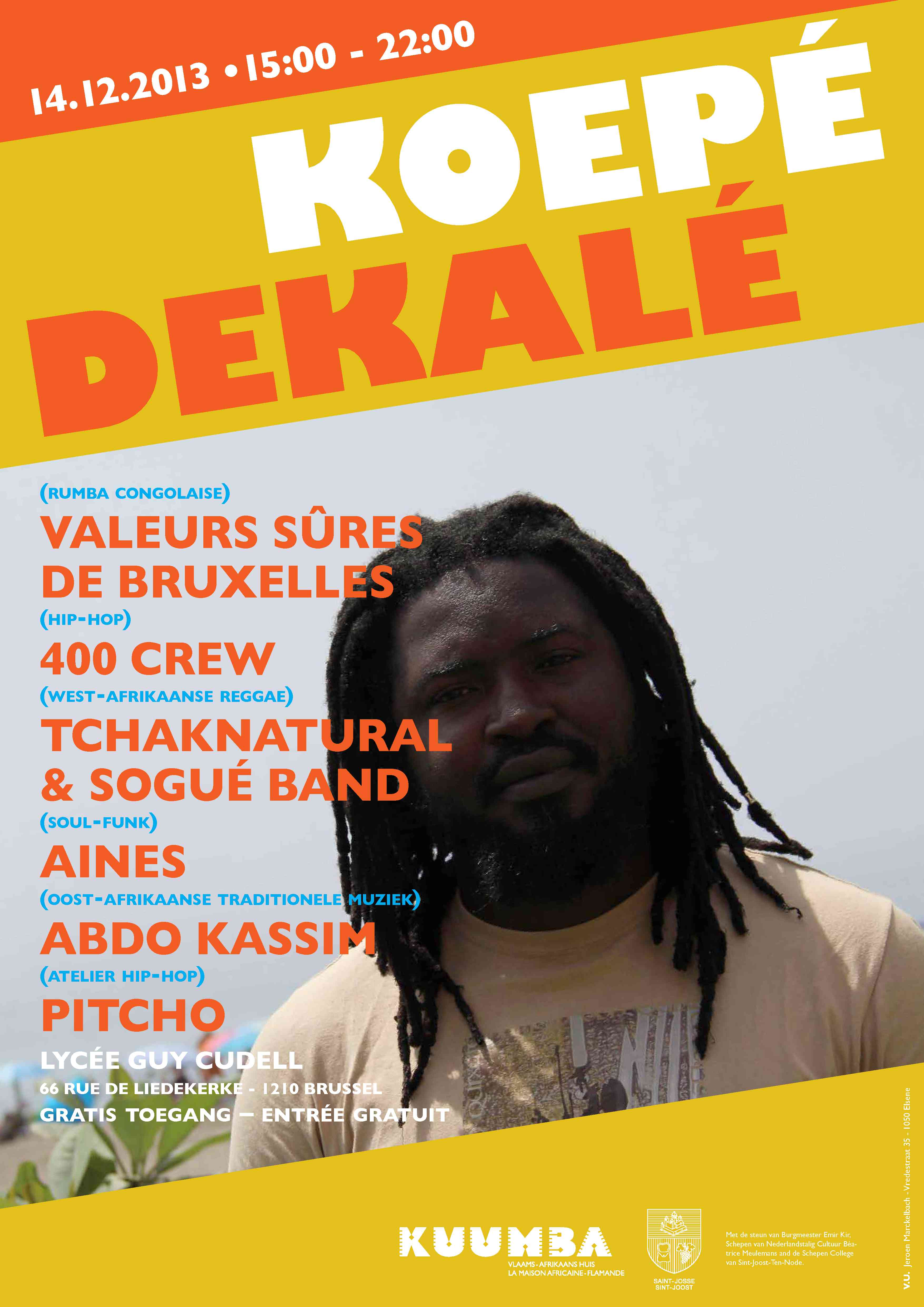
this Saturday we´ll be playing at the special FREE Koepé Dekalé festival in Sint Joost/St Josse with African contemporary, vintage and dance tunes between all the bands & groups. This festival is organised by Kuumba & commune/gemeente St Josse/Sint Joost